
THE SHORT ANSWER
A common original Furby can sell for tens of dollars.
Two used original Furbys advertised as working were marked sold on eBay in July 2026 with displayed item prices of US$25 and US$26.99. That is a useful reality check for an ordinary loose toy. It is a small sample, not a market average or a promise for yours. Packaging, a sought-after edition and documented condition can change the comparison substantially.
A box does not automatically mean hundreds, and “rare” in a listing title is not proof of rarity. Start with the exact model, then match its condition to recent completed sales. The linked examples below show what the public records actually say.
Read the sale records and their limits →A NOTE FROM MIA
The price is in the details.
It is easy to fall for the idea that a toy rescued from a cupboard is a tiny windfall. I would give that excitement a minute, then put the Furby on a clear table and make a short list: what it is, what it does and what comes with it.
That is the approach behind this guide. We reviewed competing value guides, public sold listings and auction records for this update. My advice is to leave yourself a trail of evidence: a clear label photograph, an honest test description and a handful of genuinely similar sales. It makes both buying and selling less of a guessing game.
This page focuses on the original Tiger Electronics family. For later generations and a wider overview, use our guide to how much Furbys are worth.
01 / MEET THE RIGHT MODEL
Is it an original 1998-style Furby?
“Original” is often used loosely in resale listings. Start with the physical toy and its markings, then compare it with the packaging. A copyright date is a clue to the design; it does not, by itself, establish the year that particular toy was made.
Read the underside
Photograph the maker’s wording, model number and fabric tag. Tiger Electronics and model 70-800 are useful starting clues for standard originals. A model number alone does not establish a rare colour or a valuable edition.
Look at the face
Original-style Furbys have physical eyes and moving eyelids. The LCD-eye Furby 2012 and Boom belong to later generations. Use our Furby generations guide if the family is uncertain.
Match the whole toy
Compare fur pattern, feet, ears, faceplate and any costume or promotional markings together. Our original Furby colours guide helps you narrow the search before comparing prices.
What does “Furby model 70-800 value” actually tell you?
It gives you a useful search term, not a price. Add the colour or pattern, whether it works and whether the correct box is included. A listing for a tested loose toy and a listing for an unopened box answer different buying questions, even when both use the same model number.
The Computer History Museum’s Furby record places the original toy in 1998. For valuation, however, the specific object in front of you matters more than the birthday of the brand.
02 / THE FIVE-MINUTE FIRST LOOK
Check condition before checking the price.
A seller’s “looks great” can hide several different stories. I would rather read a plain description of a stiff eyelid or a missing tag than a paragraph of superlatives. Give the next owner the information you would want yourself.
The toy
- Photograph the face, ears, feet, fur and eyelashes in daylight.
- Record stains, odours, fading, cracks, repairs and missing parts.
- With batteries removed, photograph the compartment and cover. If there is leakage, damaged wiring or heat damage, stop and seek appropriate repair advice.
- If safe to test, follow the instructions for that exact model. Record sound, movement and responses separately.
The things that came with it
- Check that the box matches the toy’s colour and edition.
- Note tears, crushed corners, faded panels and a damaged display window.
- List the instructions, dictionary, tags and inserts that are actually present.
- Describe seals precisely. “In its box” does not mean “factory sealed.”
Say what you tested and when. A sound alone is not a full function check.
Operation is unknown. Do not price or describe it as confirmed working.
Describe the observed fault. Do not promise an easy fix.
Keep a short continuous video of the actual toy responding. Photograph the battery compartment separately. This helps a buyer distinguish a functioning example from an attractive display piece, and it gives you a better basis for choosing comparable listings.
BEFORE YOU MAKE AN OFFER
Ask for the details you cannot see.
As a buyer, I would pause at a beautiful front-facing photo and ask what is missing from the view. A clear underside label and battery-bay photograph tell a different part of the story.
- Match the model, colour and included box to the listing, using photographs of the actual toy.
- Ask which movements and sounds were observed, when it was tested, and whether a short continuous video is available.
- Check for odours, replaced fur, repairs, missing parts and alterations. Clean contacts alone do not establish working electronics.
- Compare the full delivered cost and the stated return terms before choosing between offers.
03 / WHAT THE RECORDS SHOW
Original Furby value chart: five public sale examples
Reviewed on 18 October 2026. These are individual examples, not a representative price index. eBay amounts are the prices displayed on sold pages; accepted offers, payment completion and later returns are not independently verified. Auction figures are hammer prices before buyer’s fees and delivery.
| What the record describes | Date shown | Amount | How I would use it |
|---|---|---|---|
| 1998 model 70-800, used, advertised as tested working | 21 July 2026 | US$26.99 Displayed item price | A loose-original comparison. Read the seller’s full condition notes; shipping is separate. |
| Snow Leopard, used, advertised as tested working | 20 July 2026 | US$25 Displayed item price | Another ordinary used example. The condition claim belongs to the seller; we did not test this toy. |
| Grey and white original with box, listed as used | 24 August 2026 | US$39 Displayed on sold page | The page also says “or Best Offer”; the accepted amount is unverified. A box alone does not establish a premium. |
| Furby for President, described as boxed and sealed; untested | 14 April 2025 | £95 Hammer price | A named edition, not a standard loose Furby. The auction explicitly leaves operation untested. |
| Seven 1998/1999 originals with carry case and bed | 24 April 2026 | £120 Hammer for the whole lot | A collection sale. Dividing the price by seven would ignore the accessories, individual condition and bundle effect. |
The most useful lesson is the spread of situations. One seller has a played-with companion. Another has an unopened named edition. An auctioneer has seven toys to sell together. Calling all three “an original Furby” loses the detail that explains the price.
04 / MAKE IT PERSONAL TO YOUR TOY
Find a defensible price in five steps.
Once you have identified and checked your Furby, you can build a comparison that is useful to you. I would keep the list small and relevant before making it large.
Search the exact version
Use a search such as “Furby 70-800 grey white working”, then add the correct edition or packaging description. Remove Babies, keychains, spare parts and bundles unless those are what you own.
Filter for sold items
An unsold asking price tells you what somebody hopes to receive. Look for completed sales, open each listing and read the condition. If an offer hides the final amount, leave it out of your numerical comparison.
Keep like with like
Separate working, untested and broken examples. Keep loose, boxed-opened and genuinely unopened toys in different groups. Use the same country, currency and a recent date window where possible.
Record the total carefully
Write down item price and shipping separately. Use the same basis for every comparison. At auction, note whether the result includes the buyer’s premium. eBay’s Product Research tools can help sellers investigate actual sold prices.
Choose a realistic position
With several close matches, look at the middle of the group and the spread around it. Price in light of your toy’s differences and how quickly you want to sell. If you cannot find close matches, widen the date window and state that the evidence is thin.
A BETTER RESEARCH NOTEBOOK
Keep the evidence beside the number.
Save the listing link, sale date, model, condition and shipping charge alongside each price. That small habit makes it much easier to spot a misleading comparison later.
For accepted offers, eBay Product Research provides actual sold prices, including accepted Best Offers, and up to three years of data. Start with recent, close matches; older results can help with scarce editions, but they are not automatically today’s value.

YOUR COMPARABLE-SALES NOTEBOOK
Find the middle of your own examples.
Enter at least three comparable item prices, separated by commas. Use one currency and the same shipping basis. This calculates a median of your entries; it does not appraise your Furby or fetch live prices.
05 / THE BOX QUESTION
How much is an original Furby in its box worth?
The right box can make a toy more appealing, but there is no dependable “add 50%” rule. First ask whether it is an opened toy with packaging, never removed from the box, or verifiably factory sealed. Sellers sometimes use those descriptions interchangeably.
I would preserve an apparently original seal while researching the edition. Opening it to test changes what you can honestly say about its packaging. At the same time, an unopened box does not guarantee healthy electronics after decades in storage.
The Chorley example above makes that distinction neatly: the auction house described the Furby for President as sealed and untested. That is more useful than assuming “sealed” means “tested working.”
Photograph every box panel, seals, window and visible contents. Keep any receipt or provenance with the toy. For the packaging details to record, see our original Furby in box guide.
An opened toy put back in its box should be described as repacked, not unopened. Check that the inserts and paperwork belong with it, and disclose replacements. Provenance is useful when it supports a specific claim; an interesting story on its own does not establish a premium.
06 / WHEN “RARE” NEEDS A CLOSER LOOK
A special edition needs specific evidence.
Kid Cuisine, Hi-C, holiday designs and unusual variants attract collector attention. Their names are a starting point for identification, not a substitute for a matching sold record. Confirm the edition before borrowing its price.
Promotional editions
Look for the correct colour arrangement, labels and documented packaging. For a claimed Kid Cuisine or Hi-C example, request clear photographs and compare several reliable references. A colourful toy is not enough.
Named special editions
Keep Angel, holiday, Millennium and presidential toys separate from standard colour variants. “Special limited edition” printed on a box does not establish today’s demand or a guaranteed selling price.
Prototypes and customs
Ask for provenance when a seller claims a prototype or unique factory sample. A custom paint job, changed fur or unusual outfit can be creative work without being a rare production release.
I would be especially cautious with “Rainbow Furby” claims. A generic rainbow description, a customised toy and a documented competition design are different things. If the identity cannot be established, do not assign the headline price of a different object to it.
07 / GIVE THE NEXT OWNER A CLEAR PICTURE
Sell the Furby you have, with a listing people can trust.
The best listing does not need a treasure-hunt story. It needs a recognisable model, clear photos and an honest account of what happened when you tested it.
Photograph the useful details
Include the front, back, both sides, underside label, tag, feet and battery compartment. Show box panels and all included paperwork. Take close-ups of flaws rather than hoping they disappear in a wide shot.
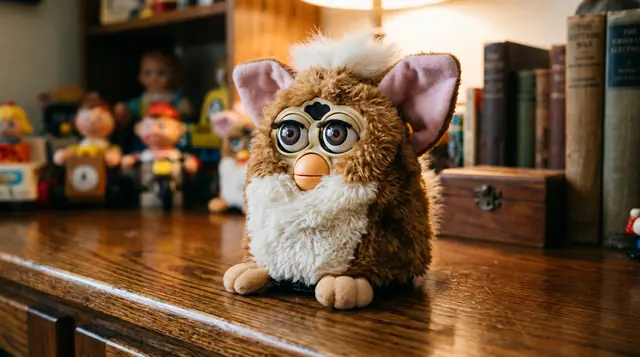
Use a plain background and natural light. Avoid colour-changing filters. Put the actual toy in every product photograph; an illustration like this article’s opening artwork would not establish what a buyer will receive.
Write a specific description
A useful title might be “Tiger Furby 70-800, grey and white, tested, no box”—but only if each detail is true. In the description, record the test date, working responses, faults, repairs, missing parts and included items.
If it is untested, say so. If it moves but makes no sound, say that. Do not use “mint” to cover over an unexamined battery compartment.
Choose the selling route to suit the item.
Online marketplaces let buyers compare many examples and inspect your photos. Check the platform’s current selling fees and protections. Local collection can reduce shipping complications for an ordinary toy or a bundle. A specialist auction may suit a well-documented unusual edition or a collection, but seller’s commission and buyer’s fees affect the economics.
The headline selling price is not your take-home amount. Subtract selling fees, postage you pay, packing materials and any agreed service costs. Use the platform’s current fee information rather than a fixed percentage copied from an old guide.
A $60 sale is not $60 in your pocket.
Suppose a buyer pays $60 for the toy plus $8 shipping: you receive $68. Subtract $8 postage, $8 in illustrative platform fees and $2 for packing materials, leaving $50 before acquisition costs, repairs and taxes.
This is an arithmetic example, not a quotation of any marketplace’s fees. Use your own charges and avoid subtracting shipping twice.
Pack the toy so its ears and face cannot be crushed or rubbed. Protect the original retail box inside a separate shipping carton; do not stick postage labels directly onto collectible packaging. FedEx’s packing guidance recommends room for 2–3 inches of cushioning on all six sides. Keep the contents from shifting, photograph the packing and use an appropriate tracked service.
08 / WHILE YOU DECIDE
Keep its story intact.
There is no need to rush from the cupboard to a sale. A little careful storage gives you time to make a good decision.
Keep it dry and shaded
Choose a stable indoor spot away from direct sunlight, damp and excessive heat. Support the box so its corners and window are not compressed.
Store without batteries
Follow the original model’s battery instructions. Remove batteries for long-term storage, and do not leave a damaged or leaking battery inside the toy.
Be gentle with cleaning
Keep water out of the electronics. Avoid immersion, machine washing or experimental solvents. Record repairs and cleaning honestly; a replaced part changes what “all original” means.
If your real aim is everyday play or a gift, compare the best Furby toys by play style before paying a collector’s premium. A vintage original and a new toy can be satisfying purchases for very different reasons.
A FEW LAST QUESTIONS
Original Furby value, without the guesswork.
How much is a 1998 Furby worth today?
Two used originals advertised as working showed sold-page item prices of US$25 and US$26.99 in July 2026. Those examples demonstrate that ordinary originals can sell for tens of dollars, but they do not establish a universal range. Match the edition, condition, packaging, country and recent sold evidence for your toy.
Is an unopened original Furby always more valuable?
No fixed premium applies. An original seal and good packaging may appeal to collectors, but the edition and demand still matter. Unopened electronics are usually untested, so the description should keep packaging condition and working condition separate.
Are broken or untested Furbys worth anything?
They can interest repairers, collectors and customisers, but value depends on the model and usable parts. Compare sold items with the same fault or untested status. Do not use tested-working prices or promise that a repair will be simple.
Does a 1998 copyright date prove I have a first release?
No. A copyright date can refer to the design rather than the manufacturing date of that individual toy. Check the model, colour or edition, labels and matching packaging together before claiming a first release or a rare variant.
Which original Furby colours are worth the most?
There is no permanent colour ranking that reliably prices every toy. Identify the exact variant and check recent comparable sales. Condition, genuine edition details and packaging can matter more than a broad description such as white, rainbow or tiger.
How much did an original Furby cost in 1998?
Contemporary launch reporting described a price of approximately US$30; later histories commonly quote around US$35. Retail and resale prices differed during the holiday rush. Neither launch price is a valuation of a surviving toy today.
Will my Furby increase in value?
Future demand is uncertain. Age, anniversaries and nostalgic attention do not guarantee a higher sale price. Choose a toy you enjoy owning, keep its documentation and condition intact, and review current sold comparisons when you are ready to sell.
HOW THIS GUIDE WAS RESEARCHED
Evidence you can follow.
This guide compares collector price guides with the public sales and auction records linked in the table. The focus is original Furby identification, observable condition and comparable sales. The five examples were checked on 18 October 2026. They explain different sale situations, not a market-wide average. A memorable price claim is useful only when its source and the toy behind it can be checked.
This is a research-based guide, not a hands-on test of the toys in the table or an independent appraisal. Marketplace descriptions remain seller claims. Public sold pages do not independently confirm payment completion. Prices exclude shipping and fees unless stated; pounds and dollars have deliberately not been combined.
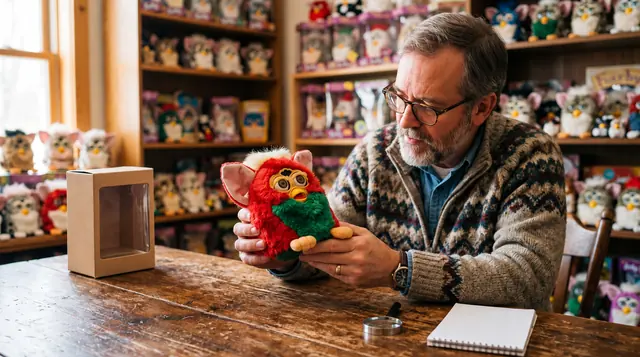
Further primary references: Computer History Museum: Furby, 1998; Wired’s contemporary October 1998 launch report; eBay’s Product Research guidance. Original artwork commissioned for this page is an AI-generated illustration, not a product photograph. The collector, research-desk and shelf scenes are AI-edited editorial illustrations. They do not document the author’s collection or identify specific sale items.
KEEP THE CHARM. CHECK THE DETAILS.
A useful price starts with a good description.
Identify the toy, record its condition, then compare it with the right sales. If the number is modest, that does not diminish the pleasure of keeping it. If the evidence points to something unusual, take the time to document it properly.
I would keep the personal decision separate from the price check. A favourite toy does not have to become a profitable collectible to earn its place on a shelf. If you do sell, passing on its paperwork and an honest account of its condition gives the next owner a better beginning.
Start with your condition check