
01 / BACK TO THE FIRST PRICE TAG
How much did a Furby cost in 1998?
The short answer is about US$30–$35. The familiar $35 figure appears in the Computer History Museum’s history, while other reports put the original toy slightly lower.
The Computer History Museum’s Furby history uses $35. Keep that figure as a reference point, then check the date, seller and currency before comparing another price.
What interests me about this question is how quickly a price becomes a memory. One person remembers the amount on the shop shelf. Someone else remembers the extra money it took to find the toy before Christmas. Put those stories together without their dates and receipts, and an apparently simple question becomes surprisingly hard to answer.
For this guide, I keep three numbers separate: the original retail price, a holiday resale price and the value of a particular Furby today. Each belongs to a different part of the story. Starting with the old reports gives us something firmer than a price repeated from one modern listing to another.
What the historical sources actually say
| Source | Price | How to read it |
|---|---|---|
| The Washington Post24 October 1998 | $30 | Contemporary retail report. |
| Federal Reserve Bank of BostonThe Ledger, spring 1999 · pp. 11–12 | $29 | A discussion of the previous holiday season’s supply and demand. |
| Computer History MuseumHistorical retrospective · 2023 | $35 | A widely cited historical reference price. |
Reading these sources together, I would describe $35 as a useful reference point, with ordinary US retail reports around $30–$35 and the Boston Fed also recording $29. The variation is part of the evidence. It does not need to be flattened into one exact price that every shop supposedly charged.
If you have an old receipt, keep the seller, purchase date and currency beside the amount. Those small details help explain why your family’s figure may differ from the one in a museum article.
A note on currency: these figures describe the United States. Converting dollars into pounds today would not establish what a British shop charged in 1998.
02 / WHAT THAT MONEY BOUGHT
A small toy with a surprisingly big presence
To understand the price, I like to look at the promise of the toy: a little creature that noticed you and seemed to answer back.
Furby’s appeal was in the response. Touch, light and sound could prompt a reaction; movement and speech gave the toy a character beyond its fur and plastic. That is the part of the original design I find most charming. A modest movement of the eyes or ears could make a familiar face feel expressive.
It reacted
The original Furby responded to touch, light and sound.
It moved
A motor, gears and cams animated its eyes, mouth, ears and body.
It became familiar
Programmed speech gradually brought English into its Furbish vocabulary.
Technology and language development: Computer History Museum.
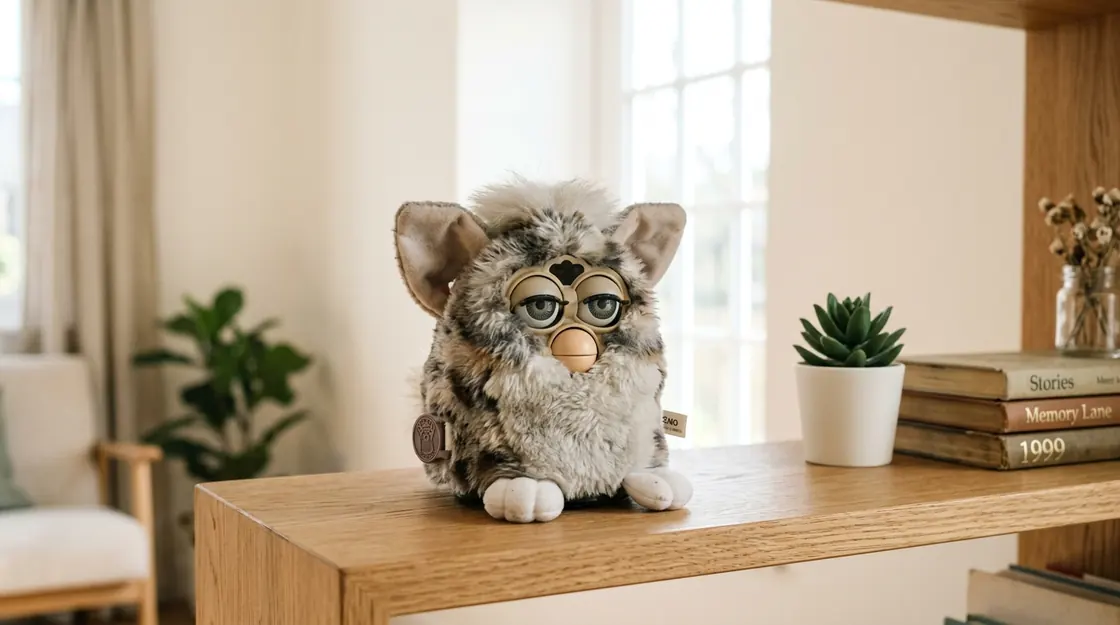
The language change deserves a little care. Furby was following programmed speech patterns; it was not picking up new words from conversations around it. The illusion of familiarity was still central to its appeal.
Those features explain what the buyer received. They do not reveal the manufacturer’s exact costs, so I have not assigned made-up dollar amounts to its motor, fur or advertising. The more useful next question is what happened when a toy with that appeal became difficult to find.
03 / WHEN CHRISTMAS CHANGED THE PRICE
Why a $30 toy could become a much more expensive gift
A price on a shelf is only useful if there is a toy on that shelf. The 1998 Christmas rush is where the original Furby price and the amount a buyer actually paid could move apart.
The shop-price question
This asks what a retailer charged for the toy at a particular time and place. It is the starting point for understanding Furby’s launch-era cost.
The availability question
The Los Angeles Times reported $30 retail and auction bids of $75 or more in November 1998.
The detail I keep coming back to is timing. A parent buying early from a shop and a buyer searching an auction close to Christmas were facing different choices. Their receipts could tell very different stories about the same generation of toy.
The Boston Fed’s account of the holiday shortage explains the supply problem: too little stock means missed sales; too much risks unsold toys. Demand rose faster than supply could catch up before Christmas. That account helps explain the scramble without assuming the shortage was deliberately engineered.
This is why I would keep postage, tax and any reseller’s premium separate when reading a family receipt. A higher total may be completely plausible. It simply answers a more specific question than “What was the original retail price?”
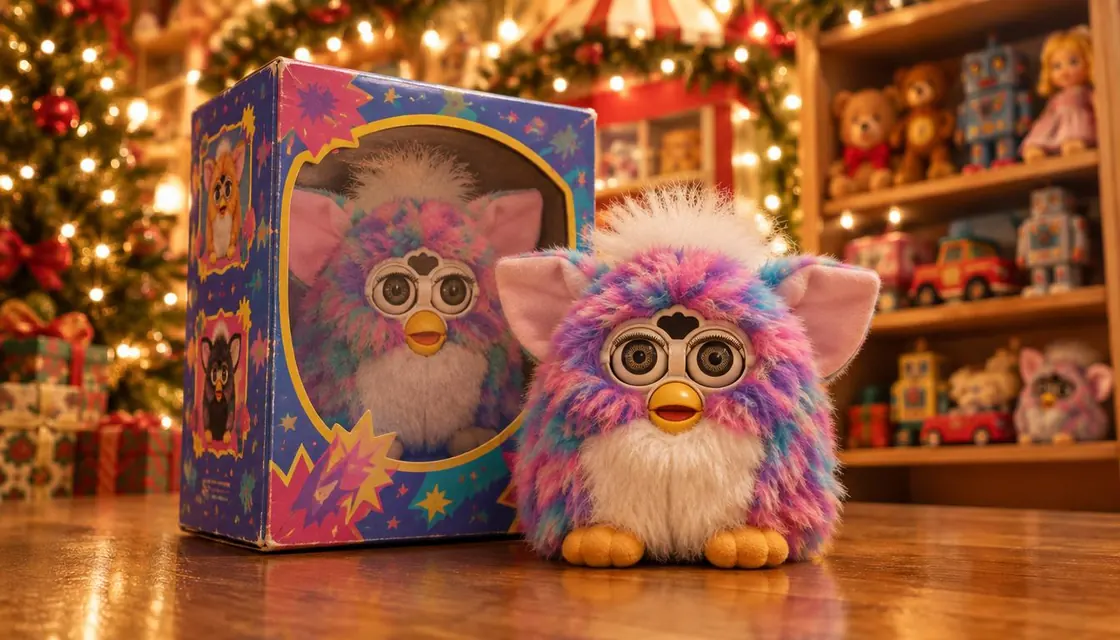
Once the holiday premium is separated out, the price history becomes easier to follow. The next source of confusion is the Furby name itself: later releases were different toys with their own launch prices.
04 / FOLLOW THE MODEL, THEN THE PRICE
How the price changed across later Furby releases
When I compare generations, I start with the model name. Otherwise, a price for a 2005 redesign or an LCD-eye Furby can easily get attached to the original 1998 toy.
This is a selection of documented US retail reference points. It gives the changes some context without pretending to be a complete catalogue of every edition, retailer or promotion.
- 1998
The original Furby
About $30–$35 in the retail reports discussed above; the Boston Fed also records $29.
- 2005
Emoto-Tronic Furby · approximately $39.99
Hasbro’s October 2005 holiday announcement, preserved by Toymania, lists $39.99 for the redesigned Furby. It is a separate release from the smaller 1998 toy.
- 2012
Furby returns · approximately $59.99
Hasbro’s September 2012 announcement gives this price for the new generation with animated LCD eyes and personalities shaped by play.
- 2013
Furby Boom · $64.99
Boston.com’s November 2013 toy guide lists Boom at $64.99, with the reminder that retail prices could vary by store.
- 2023
A new Furby generation · $69.99
Hasbro’s 2023 holiday product guide lists $69.99 for the Purple or Coral interactive toy.
The distinction between 2012 and 2013 is especially useful: Furby returned in 2012, and Furby Boom followed in 2013. Their similar appearance can make a loosely worded listing confusing. Our Furby personality changer guide separates their play responses and model differences.
Furby Connect, introduced in 2016, is another distinct generation. If you are unsure which toy you have, begin with the Furby generations guide before choosing a price comparison. A familiar brand name alone is too broad a match.
05 / PUT $35 BACK INTO PERSPECTIVE
What would the original price mean in later dollars?
The later prices raise a fair question: how large a purchase was $35 in 1998? Inflation gives us a way to compare purchasing power.
Calculation: $35 × (321.943 ÷ 163.0) = $69.13, rounded to the nearest cent.
Using the Bureau of Labor Statistics’ published annual CPI-U averages, $35 in 1998 comes to about $69.13 in 2025 dollars. Starting with $30 gives approximately $59.25. The comparison uses 2025, the latest published annual figure used here; BLS flags missing October 2025 data in the source table.
I find that comparison helpful for understanding the original purchase. It puts a small-looking old price tag into a more familiar budget. A collectible’s selling price, however, needs a separate comparison: inflation does not measure condition, packaging or demand for a particular edition.
That brings us from the toy as it was sold then to the one you might be holding now.
06 / FROM AN OLD PRICE TAG TO YOUR FURBY
Where I would start with an original Furby today
The launch price belongs in the toy’s history. To make a buying, selling or keeping decision now, I would build a short record of the actual Furby in front of me.
First, give the toy a clear identity
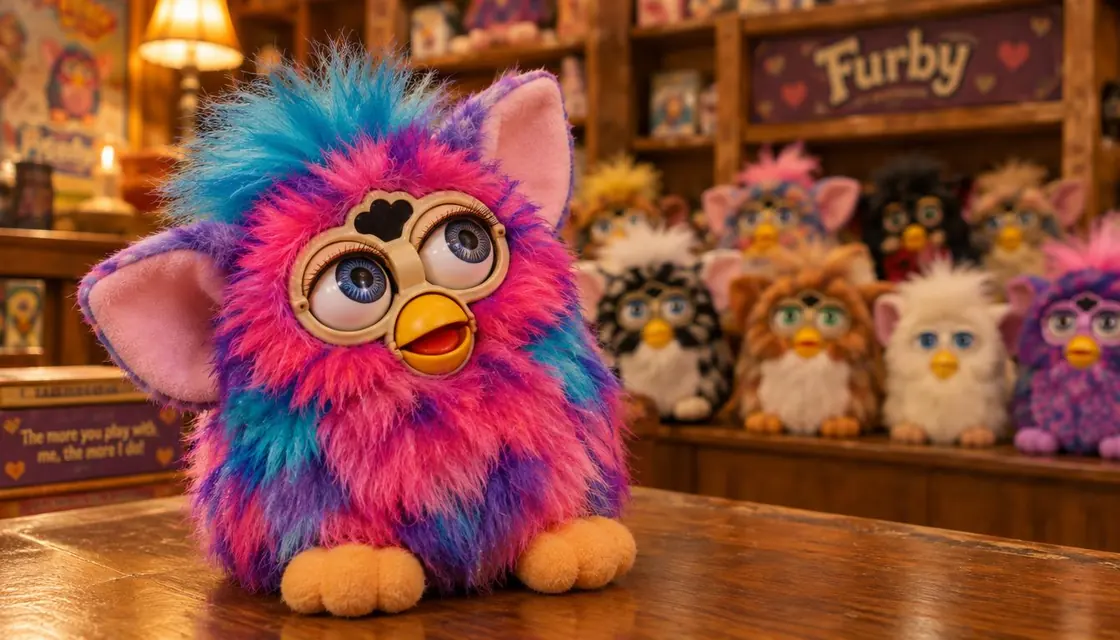
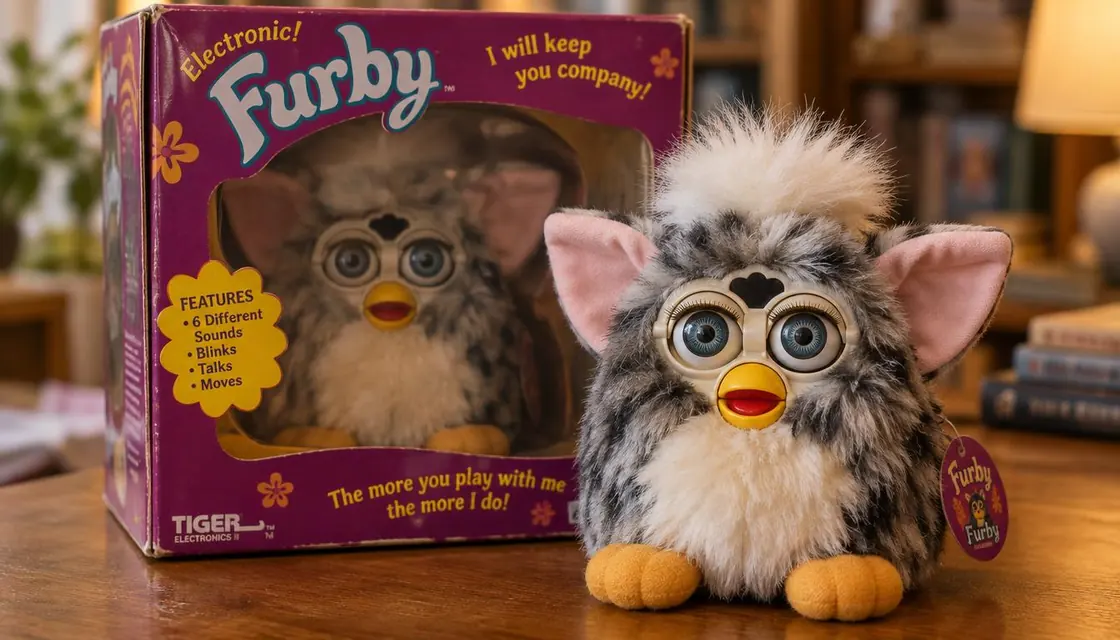
My first question would be, “Which Furby are we comparing?” Start with photographs of the front, back, underside label and fabric tag. Keep the box and instructions alongside that record if you have them. Clear photographs give you something to check when a listing’s description is vague.
Read the markings together with the physical features. The original generation has mechanical eyes; the 2012 return has LCD eyes. A copyright year is a clue, but it does not prove when an individual toy was manufactured. The original 1998 Furby guide can help with that first identification.
I would leave colour nicknames until the model is clearer. A bright coat is easy to notice, but colour alone cannot establish an edition or its rarity.
Then, describe the toy and its box separately
A box adds another part of the story to inspect. Look at its corners, fading, tears, labels and inserts. Check that the packaging matches the toy. Keep “boxed,” “unused” and “factory sealed” as separate descriptions, using only the one the evidence supports.
For the toy itself, ask for clear battery-compartment photographs and a short demonstration of sound and movement. Record missing parts, repairs, stains, odours and visible battery leakage. An attractive package cannot tell you whether the electronics work.
My rule here is to keep uncertainty visible. If a seller says “untested,” carry that word into your comparison. Follow the instructions for the exact model when checking it, and avoid forcing its mechanism or dismantling it simply to demonstrate a listing.
Give a “rare” claim something to stand on
Special editions and promotional releases need specific evidence. Ask which edition is being claimed, which markings or packaging support it, and whether the comparison sales show that same version. A custom coat or added accessory may be appealing, but it does not establish a factory-issued variant.
I would be much more comfortable with a modest claim supported by clear photographs than an impressive valuation attached only to the word “rare.” The useful question is what comparable buyers actually paid for a comparable toy.
Compare the sales that answer your question
- Match the model and condition. Choose completed sales of similar working or untested examples with similar packaging. Keep multi-toy bundles separate from single-toy sales.
- Keep the full sale record. Note the date, currency, item price, postage and relevant fees. If an accepted offer is hidden, the displayed asking price does not establish the final amount.
- Look for a pattern. Several useful comparisons give a better basis for a range than one eye-catching listing.
Our guide to how much an original Furby is worth includes public sale examples and the limits of the available evidence.
Make the next step fit your reason for looking
If you are buying, check the exact contents, working demonstration and return terms before deciding whether the price suits you. If you are selling, use your photographs and condition notes to describe the toy clearly, then check the marketplace’s current fees and shipping costs.
If you are keeping it, the same record is still worthwhile. Save a receipt, gift note or packaging detail with the photographs. A family story may be the most important part of owning that Furby, even though it cannot be converted into a reliable market premium.
THE DETAIL WORTH KEEPING
Keep the story with the price tag.
For me, the most useful answer to the original-price question is a number with its context attached: roughly $30–$35 at ordinary US retail, a different experience during the Christmas rush, and a separate set of questions for today’s collector. That leaves room for both the evidence and the affection people have for these little toys.
07 / QUICK ANSWERS
Original Furby price FAQs
How much did a Furby cost in 1998?
Ordinary US retail reports put the original Furby around $30–$35 in 1998. The Computer History Museum uses $35, while the Boston Fed’s spring 1999 account records $29. Holiday auction prices could be higher.
Was the original Furby $30 or $35?
Both appear in the historical record. Keep the source, seller, country and date with the figure. The available reports support a useful retail range rather than one price paid by every buyer.
Why do some people remember paying much more?
Christmas demand grew faster than the available supply. A buyer using a reseller or auction could pay more than ordinary retail, with postage and tax also affecting the final total.
How much did the 2005 Furby cost?
Hasbro’s October 2005 holiday announcement lists the redesigned Emoto-Tronic Furby at an approximate US retail price of $39.99. That is a price for the 2005 release.
Was Furby Boom released in 2012?
No. Furby returned in 2012, and Furby Boom followed in 2013. The historical US retail references used here are approximately $59.99 for the 2012 model and $64.99 for Boom.
Does an original $35 price make my Furby valuable today?
The original retail price does not establish present value. Identify the model, describe its condition and packaging, and compare recent completed sales of similar examples.
Does a 1999 label tell me what my Furby is worth?
A year on a label is only one clue. Check what the marking identifies, establish the model and condition, and use suitable completed sales. The year alone cannot establish rarity or value.
Is a boxed Furby always worth more than a working loose one?
There is no automatic rule. Compare the exact model, working condition and completeness of the packaging. A box does not prove that the toy works, and boxed is different from factory sealed.
How can I check what mine is worth?
Photograph the toy and its markings, document working condition and included packaging, then compare several similar completed sales. Keep postage, fees and hidden accepted offers in mind when interpreting the results.
A note on the research
Updated 19 October 2026. This guide brings together contemporary price reporting, the Boston Fed’s educational archive, the Computer History Museum, Hasbro’s product announcements and BLS inflation data. The sources sit beside the figures they support. Prices are in US dollars unless another currency is stated.
For image-use enquiries, see our image-use terms or contact Furby Toy Shop.
Back to the top ↑