
THE SHORT STORY
When did Furby come out?
Furby first came out in 1998. Dave Hampton and Caleb Chung created the toy, and Tiger Electronics brought it to market. Its big breakthrough was the 1998 holiday season. The main story then runs through Emoto-Tronic Furby in 2005, Furby 2012, Furby Boom in 2013, Furby Connect in 2016, the 2023 relaunch, DJ Furby in 2025 and Furby Vibes in 2026.
Looking for the original? Start with what a Furby cost in 1998. Trying to identify a toy? Jump to the generation comparison.
The original launch year
Sold in the first three years, according to Hasbro
A new chapter with Furby Vibes
01 / BEFORE THE CRAZE
Who invented Furby?
Dave Hampton and Caleb Chung are the inventors behind Furby. Their names appear on the interactive-toy patent, which describes a toy responding to its surroundings through coordinated movement and sound. Tiger Electronics was the company that turned the idea into a retail product.
That distinction matters. “Who invented Furby?” asks about the creators; “who made Furby?” usually asks about the manufacturer. Tiger launched the original, while Hasbro’s later releases carried the brand into new eras.
The part I find most compelling is the design problem: how do you make a small machine feel worth talking to? Furby offered a face to look at, a voice to answer and enough unexpected responses to make another interaction tempting. There was room for the owner to supply the rest of its character.
The Computer History Museum’s history of Furby puts that sense of connection at the centre of the story. Furbish gave the creature a voice of its own before familiar English phrases appeared.
02 / THE TOY EVERYONE WANTED
Why did Furby become so popular in 1998?
Furby arrived with a strong invitation: spend time with this creature and see what happens next. It reacted to touch, sound and light, moved its face and ears, and could interact with another Furby. For a child, those little responses could turn a toy into a character.
There was also a carefully built launch. The Strong National Museum of Play’s collection record describes television appearances ahead of retail availability. Anticipation met limited supply during the holiday rush.
The Computer History Museum records a typical original price of about US$35, with much higher resale prices during the shortage. Hasbro later reported more than 40 million sold worldwide in the first three years. That figure describes the early run, not every Furby ever sold.
That contrast is what makes the craze memorable to me: an enormous public fuss around a very small exchange. The headlines were about queues and shortages. Furby’s invitation was simply to touch it, talk to it and wait. The next blink or unexpected sound gave you a reason to stay a little longer.
03 / FOLLOW THE FAMILY TREE
The Furby history timeline
These are release milestones, not a claim that every model stayed in production until the next one arrived. Regional launches and individual editions can differ.
Furbish finds its first audience
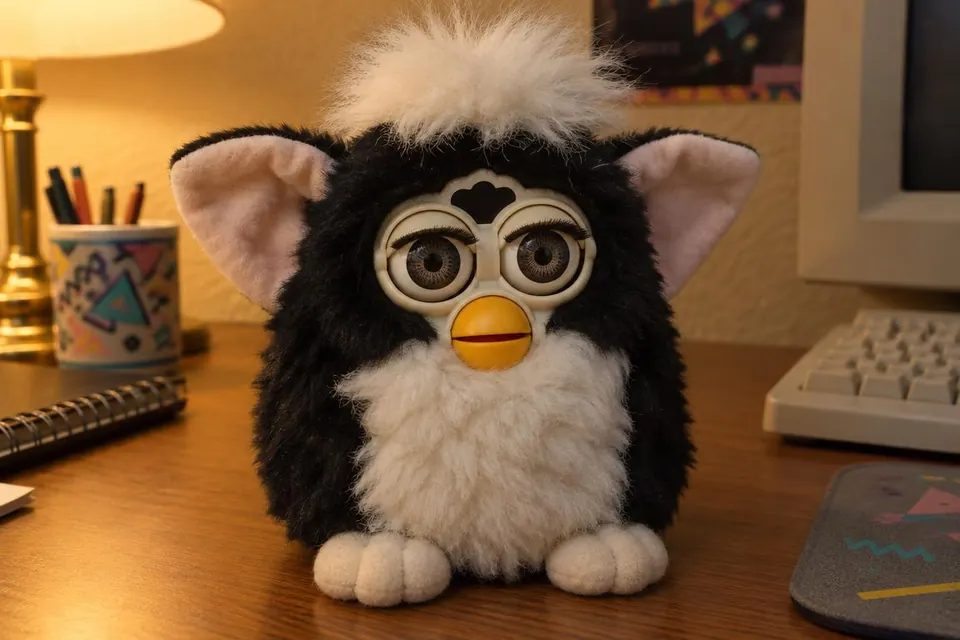
The original Furby paired a soft body with mechanical eyes, moving ears and a beak. Sensors triggered programmed responses, and infrared let nearby originals communicate. English phrases gradually appeared among the Furbish.
I start with the face before the fur colour. The moving eyelids and physical eyes belong to a different chapter from the screens that came later. A new colourway or a special outfit may make two originals look quite different on a shelf without making them different generations.
Explore the original generation →A larger face, a more direct conversation
The Emoto-Tronic redesign made Furby larger and added voice-command play. Its on/off switch and “Hey Furby” command sequence marked a different way of interacting: get its attention, wait for a response, then ask for an activity. I would keep the matching Hasbro instructions beside this model; commands remembered from another era can send you in the wrong direction.
The bigger face changes the impression straight away. It is still recognisably Furby, but the appeal has shifted toward a more direct conversation. That is a more useful way to understand this redesign than treating it as an oversized version of the original.
Personality becomes the headline
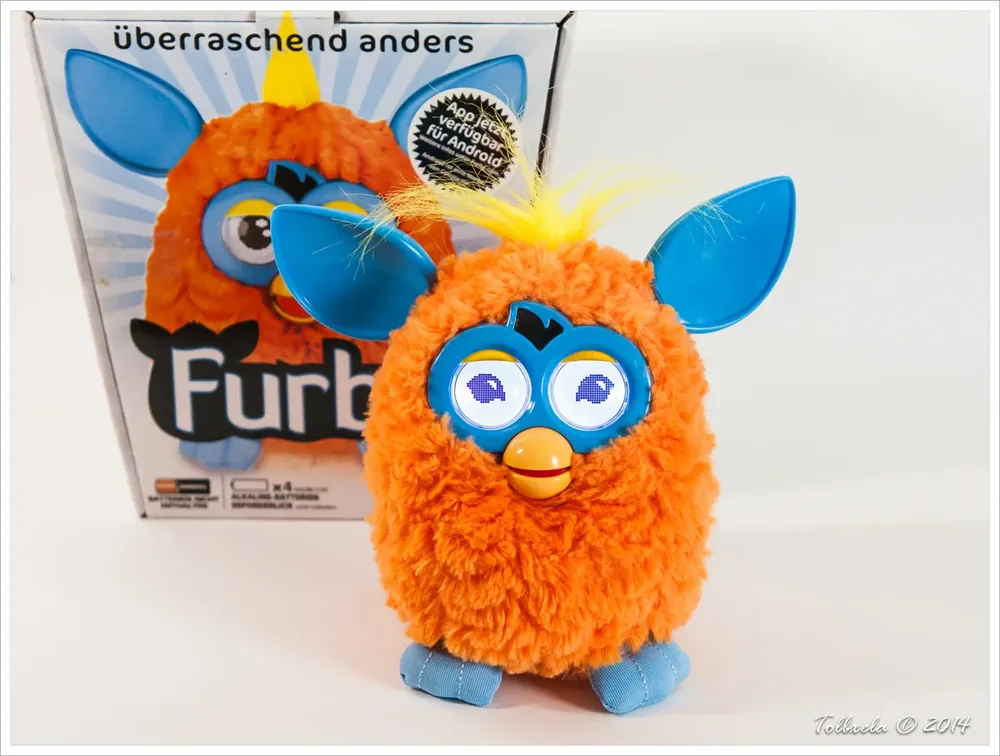
Hasbro’s 2012 relaunch introduced expressive LCD eyes and personalities influenced by interaction. Feeding, tickling, talking and music shaped the play experience. A companion app offered pretend feeding, translation and a Furbish dictionary.
This is where the family story becomes especially lively. The monochrome eyes could show expressions that physical eyelids could not, and a change in voice or behaviour became part of the entertainment. If that is the Furby you remember, our Furby personality changer guide separates the 2012 personalities from Boom’s later set.
One toy opens a little digital world
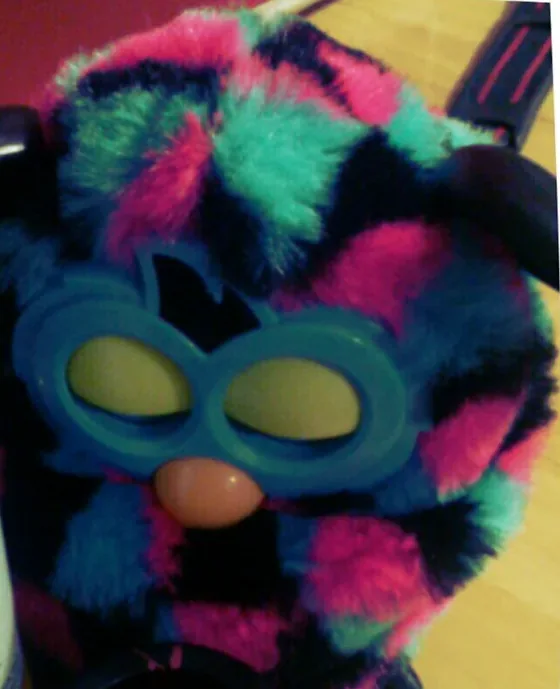
Furby Boom followed the 2012 redesign with patterned designs and a deeper app experience. Hasbro’s Boom app documentation describes caring for Furby, collecting eggs, raising virtual Furblings and playing games.
I think of Boom as the point where one companion opened up a whole little household on a screen. Its eyes were still monochrome LCDs; full-colour eyes belong to Connect. Patterned fur helps place Boom in the family, but I would check the model details before relying on the coat alone.
Colour eyes and connected entertainment
Hasbro introduced Furby Connect with colour LCD eyes, a light-up antenna and Bluetooth links to the Furby Connect World app. Its launch design included app-delivered songs, videos and other content, plus a physical sleep mask.
The antenna and colour eyes make Connect one of the easiest chapters to recognise. For me, the sleep mask is an especially appealing detail: a physical bedtime accessory for a toy built around digital entertainment. When considering one today, I would ask for the mask and a demonstration of the toy itself, then check current app availability on the device I plan to use. A launch feature list cannot settle that question.
Back to play in the room
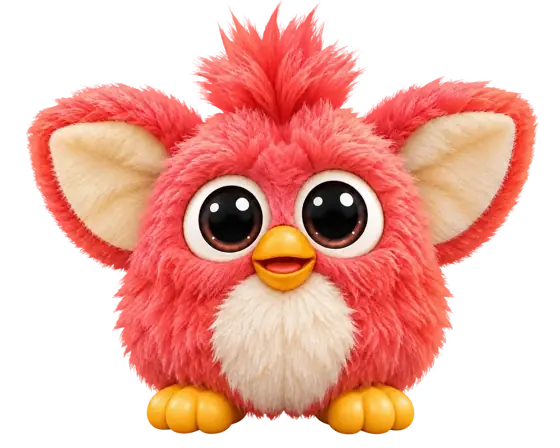
The 2023 relaunch arrived in Purple and Coral with five voice-activated modes and over 600 responses. Lights, music and accessories became central to the design. The full-size toy works without a companion app or internet connection.
What I like about this turn in the story is how much happens in the room again. The heart gem, glowing ears, music and accessories give the play session a different rhythm from the app years. If this is your model, start with our Furby commands for the 2023 generation. Older personality-change routines are not a universal set of instructions.
A longer, softer musical companion
DJ Furby’s 2025 announcement introduced a long plush body, music creation, games and five play modes. Hasbro also introduced smaller DJ Furblets. The family was expanding into different shapes and play styles, rather than simply changing the colour of the previous toy.
Choose a mood with a pair of glasses
Hasbro revealed Furby Vibes at Toy Fair 2026. Interactive glasses select Star Diva, Chill Spa or Punk Rocker modes, each with its own music and activities.
One detail deserves its own place in the timeline: Hasbro’s Vibes instructions say it speaks Furbish only. Do not expect every modern Furby to repeat the original toy’s gradual move into English. The family resemblance does not guarantee the same behaviour.
04 / THE EXTENDED FAMILY
Babies, Buddies and Furblets: similar names, different toys
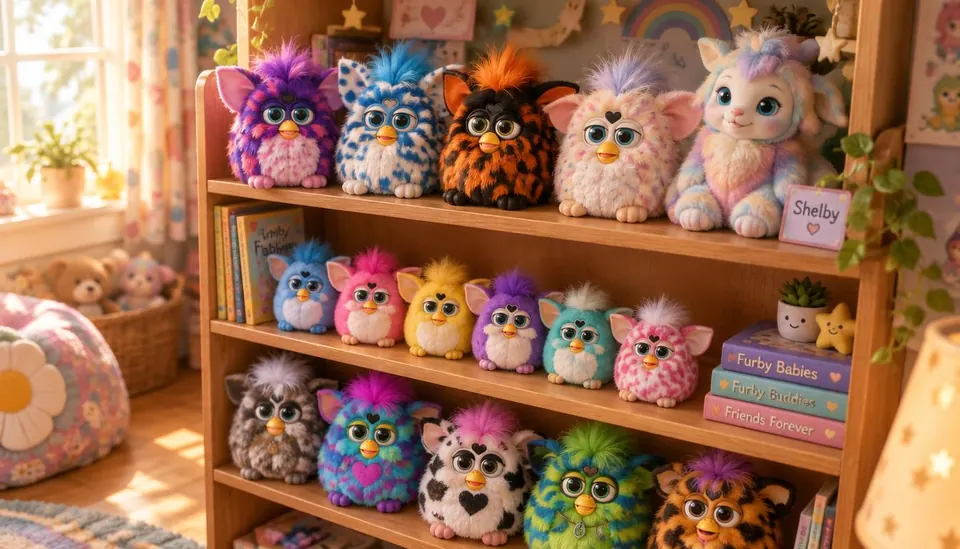
Once the main timeline is clear, the smaller companions make more sense. I find it helpful to ask what each one actually does before counting it as another generation. A soft keepsake, a miniature electronic pet and a full-size Furby offer quite different experiences.
Babies & Buddies
Furby Babies brought the electronic companion idea into a smaller toy. Furby Buddies were plush beanbag toys, so the lack of electronic responses is part of their design. Hasbro’s 1998 annual report lists Buddies and Happy Meal toys among the planned 1999 extensions. A Furby-shaped toy does not necessarily contain the original electronics.
Furblings
Boom’s virtual Furblings belonged to its egg-collecting and care activities. The similar names are an easy place to lose the thread: I check whether a listing describes a digital creature, a physical companion or the full-size toy. An accessory from the same era does not promise the same features.
Furblets
Modern Furblets are smaller musical companions. Hasbro’s Furblets instructions describe their own tunes, sounds and Furbish phrases. Their small size and musical focus make them their own branch of the family. Use the exact pack’s instructions; full-size Furby commands do not transfer automatically.
05 / THE STORIES THAT STUCK
Could Furby really learn, record or spy?
The original’s convincing responses encouraged some very unconvincing rumours. Separating the mechanism from the memory makes its history more interesting.
It seemed to learn English
The original toy progressively used words already stored in its programming. It did not build a vocabulary by recording conversations around it. Owners could influence interactions, but they were not teaching it unlimited new sentences.
That distinction preserves the cleverness of the design. A programmed progression can still create anticipation: what will it say next? For the words themselves, explore our Furbish language guide.
The restriction was real. The recorder was not.
An FAA historian’s account records the 1999 NSA and Norfolk Naval Shipyard restrictions, driven by fears that Furby could record and repeat sensitive speech. The original toy had no such recording ability.
The same account distinguishes the FAA’s advice about switching the toy off during parts of a flight from a blanket no-fly ban. These were specific institutional concerns, not a general prohibition on owning a Furby.
06 / FIND YOUR ERA
Compare Furby generations at a glance
If a Furby has lost its box, I would work from the face down: eyes first, then body shape, accessories and the label underneath. Those clues together tell a much better story than colour alone.
Three clues I would check before naming a model
- Eyes and shape. Mechanical eyes suggest an early or newer standalone design; monochrome LCDs point toward 2012 or Boom. Connect combines colour screens with its distinctive antenna.
- The product label. Photograph the base or battery-cover markings and match the product number with the toy’s features. A moulded copyright date alone is not the manufacturing date of that individual toy.
- What comes with it. A Connect sleep mask, a newer heart gem or Vibes glasses can help place the toy. I would ask to see the accessory rather than assume it is included because it appears on a box.
This also keeps special editions in perspective: a different pattern can be a lovely collecting reason without changing the underlying play system.
| Release | Recognisable feature | Historical play idea | Check today |
|---|---|---|---|
| 1998 Original | Mechanical eyes and compact body | Furbish progression and sensor responses | Moving parts, battery compartment and a working demonstration |
| 2005 Emoto-Tronic | Larger body and expressive face | Voice-command activities | Exact manual and working speech and movement |
| 2012 Furby | Monochrome LCD eyes | Personality shaped by play | Model identity; discontinued app availability |
| 2013 Boom | Patterned designs and LCD eyes | Virtual eggs, Furblings and care activities | Toy operation separately from old app features |
| 2016 Connect | Colour LCD eyes, antenna, sleep mask | Bluetooth-linked entertainment | Accessories and current app/device support |
| 2023 Furby | Heart gem and illuminated ears | Five voice-activated modes | Model-specific commands and included accessories |
| 2025 DJ Furby | Long, soft plush body | Music creation, games and relaxation | Exact full-size or DJ Furblet product |
| 2026 Vibes | Interactive glasses and bendy hair tuft | Three selectable modes; Furbish-only speech | Glasses, accessories and the matching instructions |
07 / BRING THE HISTORY HOME
What matters when collecting an older Furby?
My first question is one a price chart cannot answer: do I want a display piece, a working play companion or a particular chapter of Furby history? That choice changes what I would look for next.
Choose the experience
For mechanical nostalgia, I would start with the original. For changing expressions and voices, I would look at 2012 or Boom. If music and straightforward play matter more, the newer standalone designs deserve a look. A favourite era is a better starting point than a seller’s “rare” label.
Identify the actual toy
Ask for clear photos of the face, feet, labels and battery compartment. For a display piece, fur condition and packaging may matter most. For a working companion, I would also want to see the eyes, beak, ears and sound responding in a recent video.
Separate condition from price
A clean exterior does not prove the electronics work. Compare completed sales for the same model, condition and accessories. An unopened box can be attractive, but it also leaves the toy’s present working condition untested. I would not treat a high asking price as proof of value.
Bring it home with the right expectations
Before adding batteries to an older toy, I would inspect the compartment for leakage and check its own instructions. A non-working Furby is a different purchase from a demonstrated working one; I would price it on that basis rather than assume a quick reset will fix it.
Keep the manual’s battery and cleaning guidance with the toy. Hasbro describes current Furby models as surface-clean only. For an older model, follow its matching guide and remove batteries before long-term storage as directed. The aim is to preserve the companion, not to turn a nostalgic purchase into an improvised repair job.
For a closer look at valuation, use our original Furby worth guide. For a new play companion, compare the best Furby toys. History helps you choose a model; it does not guarantee a collector premium.
08 / QUICK ANSWERS
Furby history FAQs
When were Furbies first made?
Furbies were first released in 1998 by Tiger Electronics. The original became a major hit during that year’s holiday season. Later redesigns and smaller companion lines belong to different chapters of the brand’s history.
Who invented Furby?
Dave Hampton and Caleb Chung created Furby. They are named on the interactive-toy patent. Tiger Electronics brought the original toy to market, and Hasbro continued the brand through later releases.
When were Furbies most popular?
The original craze took off during the 1998 holiday season and continued into the following years. Hasbro reports more than 40 million sold globally during the first three years. Later revivals introduced Furby to new audiences.
How many Furby generations are there?
The count depends on what is included. This guide separates eight major release milestones: 1998, 2005, 2012, Boom in 2013, Connect in 2016, the 2023 relaunch, DJ Furby in 2025 and Vibes in 2026. Colour series, smaller companions and special editions should not automatically be counted as separate full-size generations.
Is Furby Boom the same as Furby 2012?
No. Furby Boom arrived in 2013 after the 2012 redesign. They share the LCD-eye era, but Boom introduced its own personalities and a deeper app experience involving virtual eggs, Furblings and care activities. Identify the exact model before following play or troubleshooting advice.
Did the original Furby record conversations?
No. The original 1998 Furby used programmed vocabulary and responses. Its gradual use of English helped create the impression that it was learning words from its surroundings, but it could not record and repeat private conversations.
Was Furby banned everywhere?
No. The 1999 story concerned restrictions at specific institutions, including the NSA and Norfolk Naval Shipyard. It was not a general ban on owning or selling Furby. The FAA’s historical advice about switching it off during parts of a flight was also different from a blanket flight ban.
Do all Furbies eventually speak English?
No. Language behaviour depends on the model and regional edition. The original English-language Furby progressively used preprogrammed English words, while Hasbro describes the 2026 Furby Vibes as Furbish-only. Check the exact product information.
Are old Furbies automatically valuable?
No. Model identity, condition, working electronics, completeness and demand all matter. Compare recent completed sales for closely matched toys. A high asking price or an old copyright date alone does not establish value.